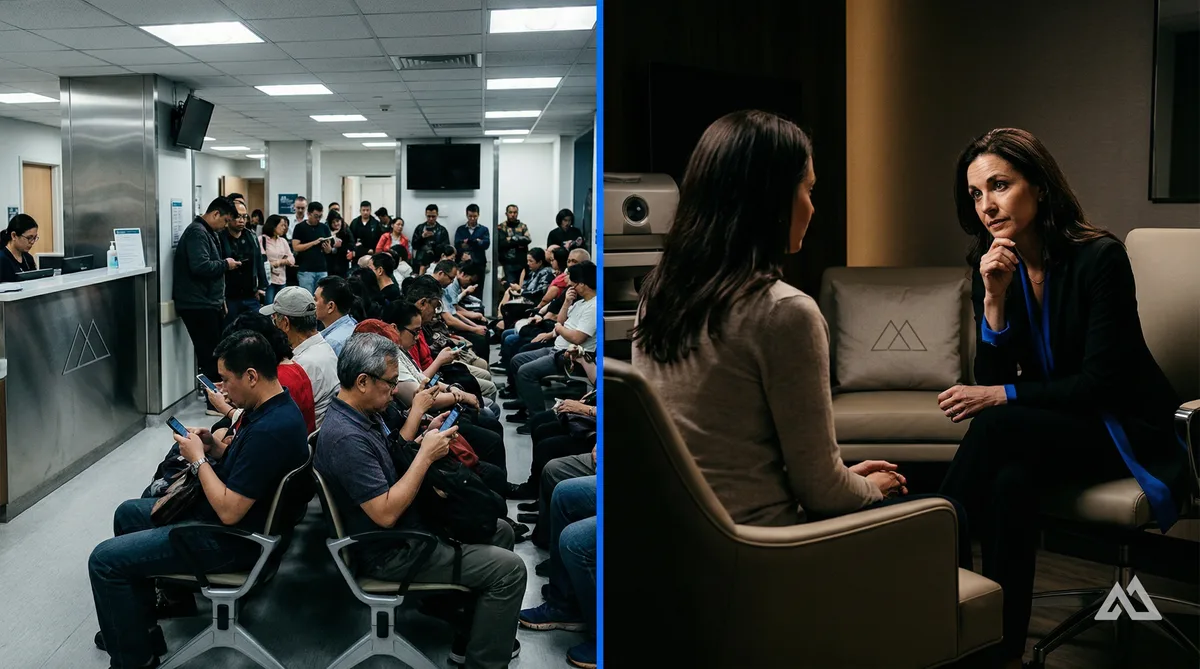
The American healthcare system is broken and getting worse. In 2024, national health spending hit $5.3 trillion. You probably feel the weight of this every time you try to see a doctor. Between seven-minute appointments, administrative gatekeepers, and a mountain of bureaucracy, the system is designed for paperwork, not for you.
People are looking for something better. This search for biological and financial agency has led to the rise of medical cost sharing—a community-based approach to managing large, unexpected medical expenses.
Medical cost sharing is a membership-based model where people with shared ethical or religious beliefs voluntarily contribute monthly to help pay for each other's medical needs. It isn't insurance, and it doesn't work like a corporate contract. It's a commitment to a community. You act as a “cash-pay” patient, which often lets you cut out the middleman and access more transparent, direct care.
What Is Medical Cost Sharing?
Medical cost sharing is a return to mutual aid. It is a framework where a community of health-conscious individuals agrees to share the burden of large, unexpected medical expenses.
Most of these communities are organized as Health Care Sharing Ministries (HCSMs). They are 501(c)(3) non-profits that have operated in the U.S. for decades. While many were originally faith-based, newer communities like Sedera are inclusive and secular. They focus on shared values like personal accountability and healthy living rather than a specific religious creed.
It is vital to understand that medical cost sharing is not insurance. It does not transfer risk to a company, and there is no legal guarantee of payment. Instead, it is an act of voluntary giving where the community follows specific guidelines to decide which medical needs are eligible for sharing.
How Does Medical Cost Sharing Work?
Medical cost sharing is designed to be simple. It's a step-by-step process that puts you back in charge:
- You join a sharing community: You become a member of a community (like Sedera) and pay a monthly contribution.
- You receive care from any provider: You aren't restricted by networks. You choose the doctor or hospital you trust and present yourself as a cash-pay patient.
- When a qualifying medical need arises, you pay your Initial Unshareable Amount (IUA): This is the fixed amount you remain responsible for before the community starts sharing.
- You submit the medical need to the community: You upload your itemized bills and documentation to the member portal.
- Eligible expenses are shared: Once confirmed as eligible under the community guidelines, funds from fellow members are used to share the remaining costs of your medical bill.
Who Is Medical Cost Sharing Right For?
Medical cost sharing isn't a universal fix, but it provides a structured approach to managing medical expenses for those who want a transparent, community-based approach.
Ideal candidates include:
- Self-Employed and Freelancers: People who don't have a group plan and want a way to manage large medical risks.
- Small Business Owners: Leaders looking for a fresh, community-based framework to support their teams.
- Early Retirees: Those between 50 and 64 who need to bridge the gap until Medicare and are facing skyrocketing marketplace costs.
- Direct Primary Care (DPC) Members: People who already pay a dedicated doctor for day-to-day care and just need a framework for large, unforeseen events.
- Health-Conscious Families: Those who value personal responsibility and want to be part of a community that encourages healthy living.
The History of Medical Cost Sharing
Medical cost sharing is built on a simple idea: take care of each other. This concept dates back to medieval guilds, where blacksmiths and weavers pooled funds to create a social safety net for members who fell on hard times.
In the 18th and 19th centuries, this evolved into fraternal benefit associations like the Masons and the Knights of Columbus. These organizations provided financial assistance and healthcare to millions of Americans long before modern insurance companies dominated the market.
The modern version of this model began in the 1980s within Amish and Mennonite communities. When the Affordable Care Act (ACA) was passed in 2010, these communities were granted a specific exemption from the individual mandate. Today, the movement has grown from 100,000 members to over 1.5 million Americans as people seek a more community-minded approach to their health.
Why Medical Cost Sharing Is Growing
Medical cost sharing is growing because the traditional system is failing both patients and doctors. The primary culprit? Administrative bloat.
The Administrative Waste Problem
Research shows that 25% of all U.S. healthcare spending—roughly $1.3 trillion—is lost to administrative waste, overcharging, and fraud. In many hospitals, administrative costs now account for more than 40% of total expenses.
| Metric | Statistic (2025) | System Impact |
|---|---|---|
| National Health Expenditure | $5.3 Trillion | 18% of the total U.S. economy |
| Administrative Waste | 25% of total spend | Over $1.3 trillion lost to non-clinical tasks |
| Physician Documentation | 2 hours per 1 hour of care | Doctors spend twice as much time on paperwork as patients |
| Burnout Excess Spending | $260 Million annually | Costs driven by high clinician turnover |
| PCP Burnout Rate | > 40% of U.S. doctors | One of the highest rates in the world |
This inefficiency is why you often feel like a number in a revolving door. Traditional doctors manage panels of 2,500 patients just to keep up with insurance paperwork. Medical cost sharing bypasses this friction by treating you as a customer who pays your doctor directly, allowing for a better relationship and more thorough care.
Medical Cost Sharing vs. Traditional Models
The traditional healthcare system is built on third-party friction. There is a gatekeeper at every turn—insurers deciding what care gets approved, adjusters debating medical bills, and administrators managing referral restrictions.
Medical cost sharing is a community-based approach that empowers you to be a savvy consumer:
- Freedom of Choice: Since there are no referral restrictions or provider networks, you go where you want. If a specialist in another state is the best for you, you can see them.
- Transparent Pricing: As a cash-pay patient, you often receive significant discounts. Doctors prefer direct payment because it eliminates their billing headaches, and they pass those savings on to the community.
- Empowered Support: Communities like Sedera provide medical concierge services and bill negotiation experts to help you navigate the system and find the best value for your care.
Medical Cost Sharing by State
While these communities are nationwide, some states have specific regulations. Sedera, for example, operates in most of the U.S. but has specific availability rules.
States where Sedera is NOT currently accepting new members:
- California
- New Mexico
- Pennsylvania
- Vermont
- Washington
Additionally, referral fees are restricted in Maryland and Montana. If you live in an available state, you can join at any time of the year—you don't have to wait for an open enrollment window.
Key Terminology You Should Know
To understand how these communities work, you need to learn the right language. This isn't just semantics—it defines the non-insurance nature of the program.
| Traditional Term | Sharing Term | What it Means |
|---|---|---|
| Premium | Monthly Contribution | The voluntary amount you pay to the community |
| Deductible | Initial Unshareable Amount (IUA) | The fixed amount you pay per medical need before sharing |
| Claim | Medical Need | The specific illness or injury you submit for sharing |
| Plan | Program / Membership | The framework you choose when you join |
| Coverage | Eligible for Sharing | Expenses that meet the community's guidelines |
| Pre-existing Condition | Existing Medical Condition | A health issue present before joining (subject to limits) |
Frequently Asked Questions
Is medical cost sharing insurance?
No. Medical cost sharing is a voluntary community where members help pay each other's medical bills. It is not a contract for risk transfer and does not guarantee payment.
What is the Initial Unshareable Amount (IUA)?
The IUA is the fixed amount you agree to pay for each new medical need (like an illness or injury). Once you meet this amount, eligible expenses are submitted to the community for sharing.
What states allow medical cost sharing?
Most states allow medical cost sharing. However, Sedera is currently not accepting new members in CA, NM, PA, VT, and WA.
Can I use medical cost sharing with Direct Primary Care?
Yes. Pairing cost sharing with Direct Primary Care (DPC) is often called the “gold standard” for proactive health. DPC handles your day-to-day care, while the sharing community handles large, unexpected needs.
Who is medical cost sharing right for?
It is ideal for self-employed individuals, small business owners, and families who want a transparent, community-based approach to managing medical expenses.
Ready to see what this looks like in practice?
The Breakaway
The future of healthcare is moving toward bundled, high-performance models. The Breakaway by Rebel Health Alliance (RHA) is the first model to bundle three distinct pillars into a single membership: 01 Health Optimization (3,000+ biomarkers and DNA testing), 02 High-Performance Primary Care (unlimited physician access via DPC), and 03 Community-Backed Financial Protection (paired with Sedera Medical Cost Sharing). This ensures you have both the data-driven strategy to optimize your health and a community-backed framework for when life happens.
Required Disclaimer: Rebel Health Alliance is a marketing affiliate of Sedera. Neither Rebel Health Alliance nor Sedera is an insurance company. Membership in Sedera is not insurance and does not guarantee payment of medical expenses. Members are able to pair Sedera Medical Cost Sharing membership with a DPC (Direct Primary Care) Provider. DPC pairing is optional and not included in a standard Sedera membership. The Sedera Membership may not be available in all states.