A patient came to me last year — 48 years old, fit, no complaints. He'd been getting annual physicals for a decade. Every year, his doctor told him his cholesterol was fine. Blood pressure, fine. Everything, fine.
I ran an expanded panel. His ApoB was 142 mg/dL. Fasting insulin, 14. This guy had been quietly marching toward a cardiac event for years, and nobody caught it. Not because his doctor was incompetent. His doctor was working inside a system that doesn't allow for that kind of medicine.
That gap — between what standard primary care checks and what actually predicts disease — is why concierge medicine exists. And it's not a small gap. It's enormous.
The Economics That Broke Primary Care
Here's the math that explains almost everything wrong with the traditional model.
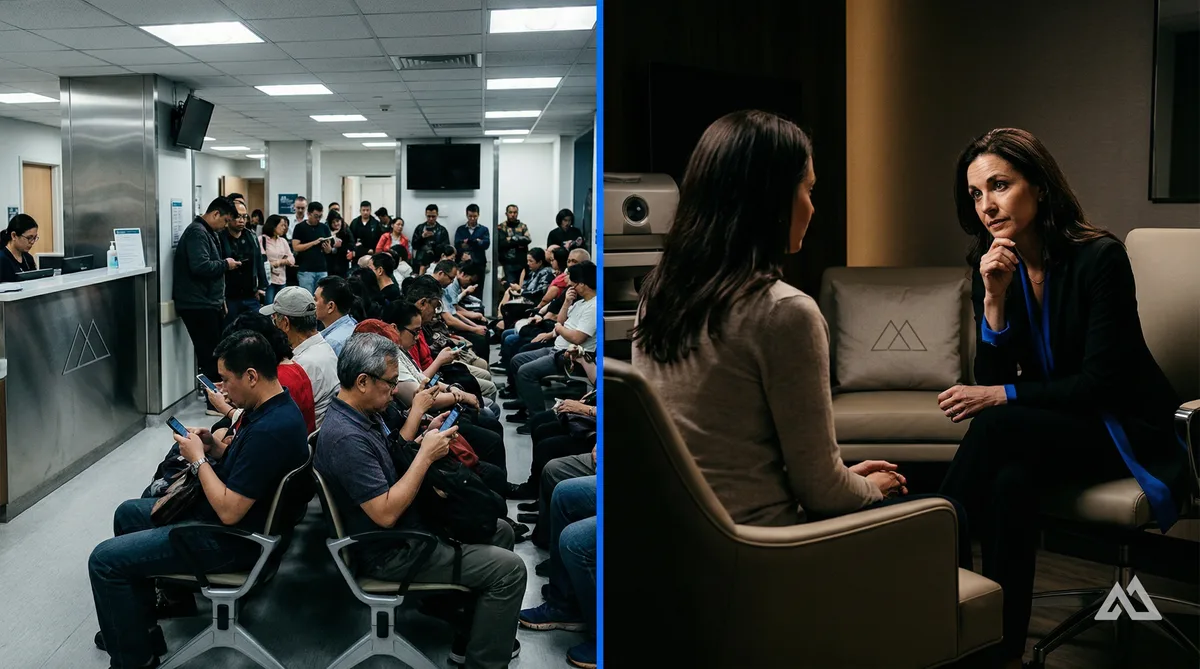
The average primary care physician in the U.S. manages 2,000 to 2,500 patients. Some carry over 3,000. Third-party payer reimbursement runs $75 to $150 per visit, which means physicians need to see 20 to 30 patients per day just to keep the lights on.
Eight hours. Twenty-five patients. That's about 18 minutes per patient, and that includes charting, pulling up records, walking between rooms. Actual face time? Studies peg it at 7 to 13 minutes.
Sinsky et al. documented the paperwork burden in a 2016 study in the Annals of Internal Medicine — for every hour physicians spent with patients, they spent nearly two additional hours on EHR documentation and administrative tasks (Sinsky C, et al. Ann Intern Med. 2016;165(11):753-760). Subsequent analyses have confirmed the ratio holds. The system wasn't designed around patient care. It was designed around billing codes.
I want to be clear: this isn't an indictment of primary care doctors. Most of them went into medicine to help people. The system just makes it almost impossible to practice the way they were trained.
What Actually Changes in Concierge Medicine
Concierge medicine restructures the economics. A membership fee paid directly by the patient means the physician can stop chasing volume. Here's what that buys you in practice.
Smaller Panels, More Brain Space
Most concierge practices cap at 200 to 600 patients. That single change cascades into everything. Your doctor has the capacity to actually think about your case — not just react to your chief complaint in the seven minutes they've got.
Appointments That Don't Feel Like Speed Dating
A typical concierge visit runs 30 to 60 minutes. Some initial consultations go 90 minutes. There's time to dig into family history, lifestyle factors, medication interactions, the stuff that matters but gets skipped when you're one of 25 patients that day. Seven minutes was never enough. It was just all the system could afford.
Same-Day Access
With 300 patients instead of 2,500, there's actual room on the schedule. Most concierge practices offer same-day or next-day appointments. Many give you direct phone, text, or email access to your physician. No front-desk gatekeeper filtering your concerns.
Testing That Goes Beyond the Basics
This is the part I care about most, because it's where the clinical difference hits hardest.
A standard annual physical typically checks:
- Complete blood count (CBC)
- Basic metabolic panel (BMP)
- Standard lipid panel (total cholesterol, LDL, HDL, triglycerides)
- Maybe a hemoglobin A1c if you're over 45
That's roughly 15 to 20 biomarkers. And the reference ranges used to flag "abnormal" are built from population averages — including sick people, sedentary people, people on five medications. "Normal" on that scale is a pretty low bar.
An optimization-focused concierge practice tests far more. At Rebel Health Alliance, members have access to over 3,000 diagnostic tests — the most comprehensive diagnostic assessment on the market. Our extensive biomarker panels include:
- ApoB — the single best blood-based predictor of cardiovascular risk, per the European Atherosclerosis Society consensus (Nordestgaard BG, et al. Eur Heart J. 2017;38(32):2459-2472). Almost never ordered in standard care.
- Lp(a) — genetically driven cardiovascular risk factor. Roughly 20% of the population has elevated levels and most don't know it.
- Fasting insulin — catches insulin resistance a decade or more before glucose goes abnormal
- hs-CRP — high-sensitivity inflammation marker tied to atherosclerosis, cancer risk, and neurodegeneration
- Complete thyroid panel (TSH, free T3, free T4, reverse T3, thyroid antibodies — not just TSH alone)
- Full hormone panel (testosterone, estradiol, DHEA-S, cortisol, progesterone)
- Homocysteine, ferritin, vitamin D, B12, magnesium RBC
- SHBG, IGF-1, and metabolic markers that most physicians never think to order
The difference between 15 biomarkers and access to thousands of diagnostic tests isn't incremental. It's a different category of medicine entirely.
Where Standard Primary Care Still Makes Sense
I'll be direct — concierge medicine isn't the right fit for everyone.
Standard primary care works well if:
- You're generally healthy, under 35, with no major family history of chronic disease
- You mostly need acute care — strep throat, ear infections, a sprained ankle
- You like your current doctor and feel you get enough face time
- Budget is a hard constraint right now
Nothing wrong with any of that. Basic primary care handles the basics.
The problem shows up when people assume their annual physical is keeping them healthy. Usually, it's confirming that nothing has gone detectably wrong yet. Those are very different things.
The Gaps I See in My Practice Every Week
These aren't theoretical concerns. I see them constantly.
Cardiovascular disease kills about 700,000 Americans per year — still the leading cause of death, per the AHA's Heart Disease and Stroke Statistics. The standard lipid panel checks total cholesterol, LDL, HDL, and triglycerides. It misses ApoB and Lp(a), two markers that flag risk in people whose standard panel looks clean. I've had patients walk in with "perfect" cholesterol and an ApoB over 130. Without running the test, they'd have spent another decade thinking they were fine.
Type 2 diabetes affects over 37 million Americans, with another 96 million prediabetic (CDC National Diabetes Statistics Report). The standard screen — fasting glucose — doesn't catch a problem until insulin resistance is well advanced. Fasting insulin spots the dysfunction 10 to 15 years earlier. A decade of correctable metabolic dysfunction, invisible to standard testing. Sit with that for a second.
Hormonal decline gets waved off as "just aging." I had a 44-year-old guy come in last fall — exhausted, gaining weight, couldn't focus. His previous doctor told him to sleep more and exercise. His total testosterone was 280 ng/dL. We started optimization and within three months he felt like a different person. Most men over 40 have never had their testosterone checked. Most women entering perimenopause get told their symptoms are stress. These aren't rare complaints. They're the norm, and they're treatable.
Cancer screening follows population-level guidelines — colonoscopy at 45, mammogram at 40. Personalized risk assessment using genetics and family history? Rarely happens unless you push for it.
Standard medicine catches disease after it shows up. The whole point of a proactive model is to catch the trajectory while there's still time to bend it.
Side-by-Side Comparison
| Factor | Traditional Primary Care | Concierge Medicine |
|---|---|---|
| Patients per doctor | 2,000 - 3,000 | 200 - 600 |
| Appointment length | 7 - 13 minutes | 30 - 60 minutes |
| Wait for appointment | Days to weeks | Same day or next day |
| Lab tests per year | 15 - 20 basic biomarkers | 60 - 100+ advanced biomarkers |
| Physician access | Office hours, through front desk | Direct phone/text/email |
| Focus | Disease treatment (reactive) | Disease prevention + optimization (proactive) |
| Care coordination | Referral, then you're on your own | Physician quarterbacks all care |
| Follow-up | "Call us if it gets worse" | Scheduled check-ins, protocol adjustments |
A table always oversimplifies — the lived experience of these two models is harder to capture in columns. But the structural differences are real, and they produce measurably different outcomes. Research published in the American Journal of Managed Care (Klemes A, et al. Am J Manag Care. 2012;18(4):e148-e154) documented lower emergency room utilization and better chronic disease management among concierge patients compared to matched traditional-care cohorts.
Not All Concierge Practices Are Created Equal
The label "concierge medicine" covers a wide range of clinical approaches. Worth understanding the tiers before you sign up.
Access-focused concierge (MDVIP, SignatureMD): Smaller patient panels, better access, but the testing and clinical approach often look a lot like traditional care with more time. You get a longer appointment. The medicine itself? Often not dramatically different. Typical cost: $1,800 to $2,200 per year.
If all you want is more face time with your doctor, this tier delivers. But if you want proactive testing and optimization, ask hard questions about what's actually included before writing a check.
Optimization-focused concierge (Rebel Health Alliance, select independent practices): These combine access advantages with advanced diagnostics, longevity science, and ongoing protocols. You get a full medical team — physician, dietitian, strength coach — not just a solo doc. Typical cost: $5,000 to $10,000 per year.
Elite longevity programs (Fountain Life, Peter Attia's Early Medical, Human Longevity Inc.): The deepest programs available — full-body MRI, coronary calcium scans, AI-driven diagnostics, dedicated physician teams. Exceptional care. Typical cost: $15,000 to $100,000+ per year.
At Rebel Health Alliance, we sit in the optimization tier on purpose. That's where we think the highest value lives for the most people. Our program delivers the clinical depth you'd find at a $20,000+ longevity program — a full medical team (physician, dietitian, strength coach), DNA testing, access to over 3,000 diagnostic tests, hormone optimization, on-demand physician access, nutrition coaching, and strength coaching — for $6,970 per year (or $697/month with a one-time $1,000 setup fee).
What to Ask Before You Switch
If you're considering a concierge practice, here's what I'd want to know.
How big is the panel? Over 600 patients and you're still going to feel the squeeze. Access advantages erode fast above that number.
What testing is included — specifically? Ask for the biomarker list. If they can't produce one, keep looking. "Advanced blood work" without specifics usually means a standard panel with a fancier name.
Reactive or proactive? A concierge practice that just treats illness faster is an improvement. But it's still playing defense. You want a team that's hunting for problems before they become diagnoses.
Who else is on the team? A solo physician beats a 2,500-patient mill every time. But a multidisciplinary team — physician, nutritionist, exercise specialist — delivers compounding results no single practitioner can match.
How do they track results? One-time testing gives you a snapshot. Longitudinal tracking — watching biomarkers shift across quarters and years — gives you a trajectory. That trajectory is the most valuable data in medicine.
What happens between visits? If the answer is "nothing until your next appointment," the program's incomplete. Coaching, check-ins, and protocol adjustments between consultations are where behavior actually changes.
Making the Switch
Moving from standard primary care to concierge is a real financial commitment. It also requires you to take an active role — showing up, following protocols, tracking data. It's not a passive purchase.
But weigh it against what most people spend. The average American pays over $13,000 per year on healthcare, most of it flowing toward reactive treatments after problems have already developed. That spending doesn't make people healthier. It funds a system that waits for things to break and then charges to fix them.
Concierge medicine flips the model. You invest in not getting sick. You invest in data, in physician relationships, in catching problems when they're small and cheap to fix. For the people who do it, it tends to be the highest-return health decision they've ever made.
Common Questions
Do I still need major medical or catastrophic protection? Yes. Concierge medicine covers your physician relationship and proactive care. You still want protection for emergencies, hospitalizations, surgeries, and specialist procedures. Many of our members pair their Rebel Health Alliance membership with a medical cost-sharing community, which they find fits well alongside their concierge membership.
Rebel Health Alliance is a marketing affiliate of Sedera. Neither Rebel Health Alliance nor Sedera is an insurance company. Sedera's Medical Cost Sharing Community is a Health Care Sharing Ministry. Membership in Sedera is not an insurance policy and does not guarantee the sharing of any medical expenses.
Can I use my existing major medical to pay for a concierge membership? Typically no. The membership fee goes directly to the practice. Some practices submit specific services for reimbursement, but the membership itself is a direct payment.
Is concierge medicine only for wealthy people? It started that way. The earliest practices catered to executives and high-net-worth families. But the market's diversified a lot. Programs like Rebel Health Alliance exist specifically to bring physician-led, optimization-focused healthcare to a broader population. At roughly $580 per month, our program costs less than what many people spend on a gym membership, personal trainer, and random supplement stack combined.
What about specialists? A good concierge physician acts as your medical quarterback. When you need a specialist, they handle the referral, review the recommendations, and fold everything into your overall protocol. You're not stuck trying to coordinate a fragmented system by yourself.
How quickly will I see results? Depends on where you're starting. Most of our members get their first full panel results within the first month, and we've built a protocol around those results by the end of month two. Tangible changes in energy, body composition, and lab markers? Usually by quarter two. But this isn't a 30-day fix. It's a long game.
Curious what physician-led, optimization-focused healthcare looks like in practice? Schedule a free 15-minute consultation with Rebel Health Alliance. We'll walk you through what we test, how the process works, and whether the program fits your situation. No commitment. No pitch.
You can also check the How It Works page for a detailed breakdown, or browse our FAQ for the most common questions about testing, membership, and the program.